
Platform
What Is Zenative
Zenative is the enterprise AI platform for turning every brand interaction into insight, action, and measurable business outcomes.
Zenative is the enterprise AI platform for brand interaction. We help companies turn every customer conversation into something their teams can act on: a better answer, a qualified lead, a clearer customer profile, a faster service workflow, or a new signal about market demand.
We built Zenative for enterprises where customer questions are complex, knowledge is distributed across teams, and every interaction matters. The platform connects the channels where customers already engage, grounds AI responses in enterprise knowledge, and gives business teams a repeatable way to move from interaction to insight to conversion.
Why We Built Zenative
Enterprise customer engagement has changed. Buyers expect instant answers, but many products still require deep technical context. Sales teams need better signals, but inbound demand is often scattered across websites, product pages, campaigns, social channels, events, and support conversations. Service teams need consistent knowledge, but the best answers are often locked inside documents, spreadsheets, systems, and expert teams.
Zenative brings those pieces together. Customers can ask questions wherever they already are. AI Agents respond with domain-specific knowledge and scenario-aware guidance. Behind the scenes, the platform captures customer needs, intent, behavior, and next actions so marketing, sales, service, and operations teams can keep moving without losing context.
That is the core loop of Zenative: every interaction creates insight, every insight drives better conversion, and every conversion improves the next interaction.
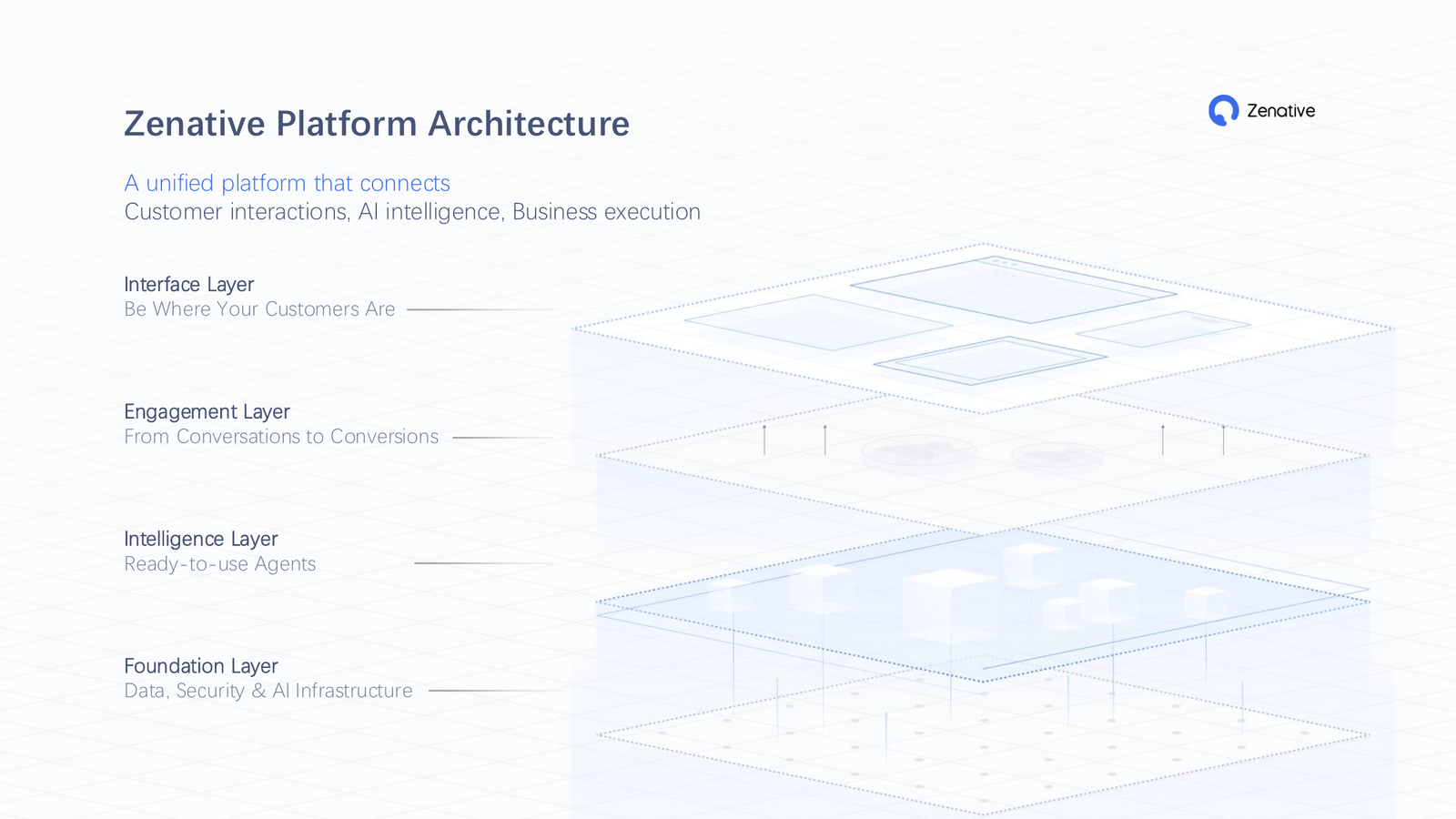
The Four-Layer Platform Architecture
Zenative is organized into four layers that work together across the customer journey.
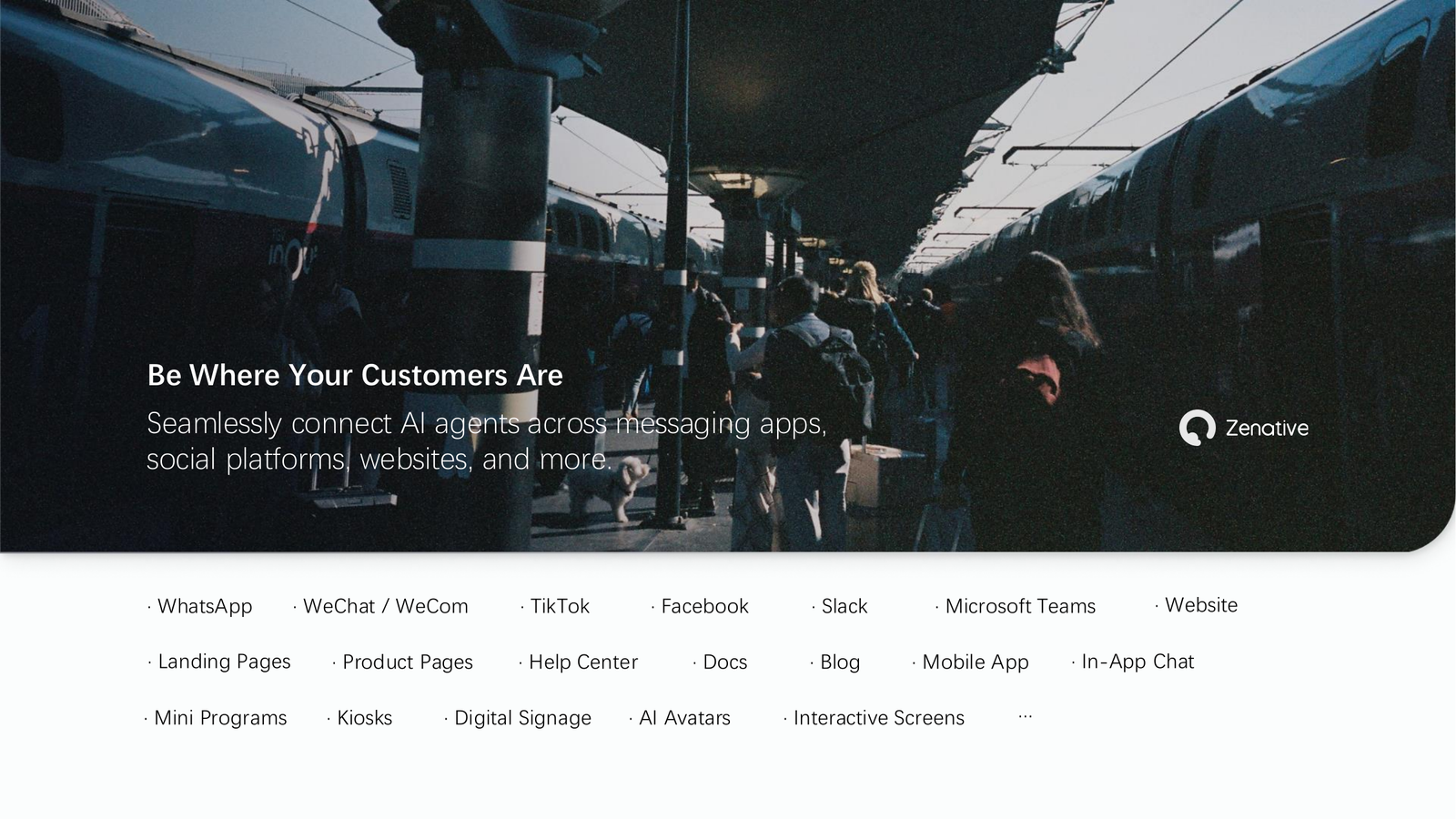
The first layer is the Interface Layer, where AI Agents meet customers. Zenative can support agents on websites, product pages, help centers, docs, blogs, mobile apps, WhatsApp, WeChat / WeCom, TikTok, Facebook, Slack, Microsoft Teams, mini programs, kiosks, digital signage, interactive screens, and AI avatars. The goal is simple: meet customers where they already are.
The second layer is the Engagement Layer, which turns conversations into business momentum. Zenative analyzes sessions, behavior signals, and historical patterns to identify customer profiles, topics of interest, hidden needs, and better follow-up actions. Sales and marketing teams can use these insights to personalize outreach, prioritize accounts, and guide customers toward the right next step.
The third layer is the Intelligence Layer, where ready-to-use agents and Skill Hub capabilities live. Teams can start from templates for common industries and scenarios, then configure agents around their brand voice, knowledge scope, business goals, and workflows. Skill Hub makes agents more than text generators by giving them reusable capabilities such as retrieval, analysis, form handling, quotation support, sample requests, and lead capture.
The fourth layer is the Foundation Layer, covering enterprise knowledge, security, and AI infrastructure. Zenative turns documents, spreadsheets, images, and websites into AI-ready knowledge. It supports knowledge segmentation, entity detection, semantic enrichment, duplicate and conflict detection, authoritative source designation, and relationship mapping across products, materials, applications, and user intent.
What Makes Zenative Enterprise-Ready
The hardest part of enterprise AI is usually not connecting a model. It is making AI reliable enough for real business. Zenative is designed around the capabilities enterprises need before AI Agents can move from a pilot into production.
First, agents need expert answers. Zenative grounds responses in the company’s products, technical materials, business context, and market needs instead of relying on generic model output.
Second, agents need action-ready skills. After a consultation, Zenative can support workflows such as quotations, contracts, sample requests, lead qualification, sales follow-up, and service escalation instead of stopping at a correct-looking paragraph.
Third, agents need scenario-specific workflows. Marketing, sales, and service teams deal with different customer journeys, so Zenative helps agents guide users through specific business processes rather than reuse the same generic Q&A pattern everywhere.
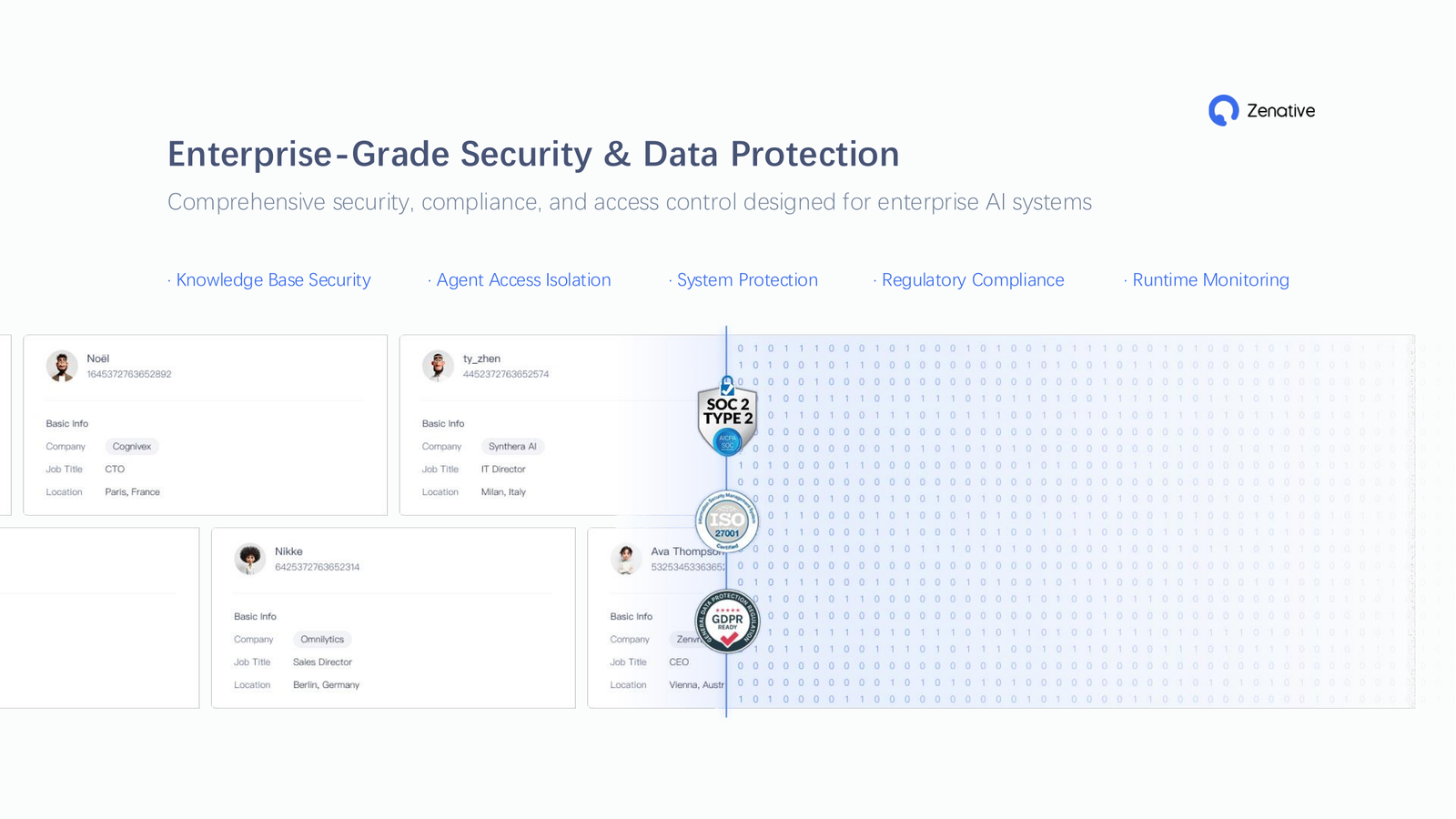
Finally, enterprises need governance and security. Zenative supports knowledge base security, agent access isolation, system protection, compliance requirements, runtime monitoring, and flexible LLM integration so teams can deploy AI with confidence.
What Zenative Helps Enterprises Achieve
Zenative is built for industries where product knowledge is dense, customer questions are technical, and traditional human support is difficult to scale across every channel and time zone. That includes complex B2B categories such as ingredients, specialty chemicals, industrial automation, and other knowledge-intensive markets.
Across these scenarios, Zenative helps enterprises deliver 24/7 product consultation, extract technical demand, guide sample requests, recommend products across business units, automate after-sales support, capture event leads, and personalize outreach based on customer profiles. The result is a more responsive customer experience and a clearer path from conversation to qualified opportunity.
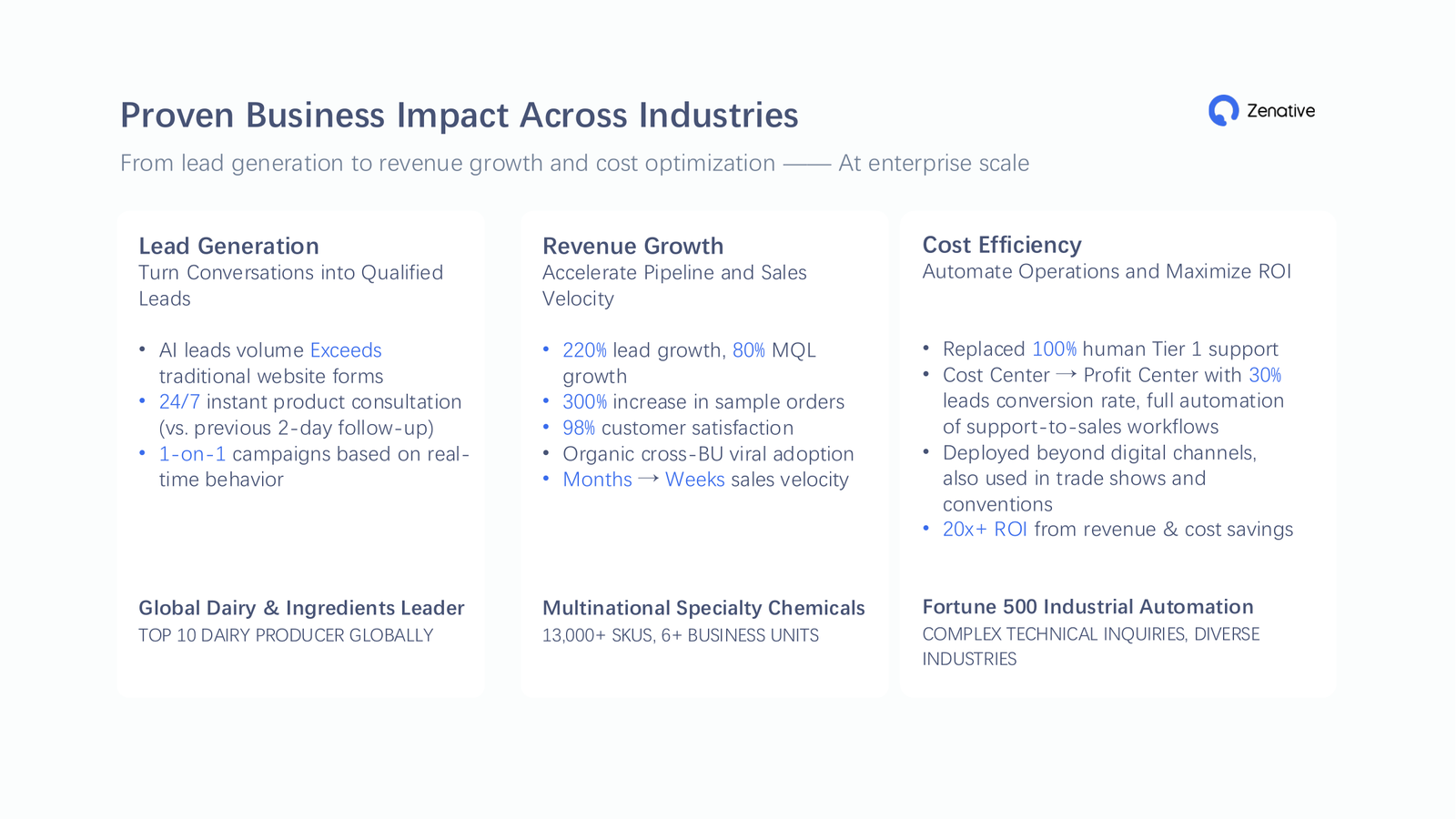
Examples of measured impact include:
- Lead generation: AI-led conversations exceeded traditional website forms, enabled 24/7 instant product consultation instead of two-day follow-up, and supported one-to-one campaigns based on real-time behavior.
- Revenue growth: customer deployments saw 220% lead growth, 80% MQL growth, 300% more sample orders, 98% customer satisfaction, and sales velocity moving from months to weeks.
- Cost efficiency: Zenative replaced 100% of human Tier 1 support in one support model, helped turn a cost center into a profit center with a 30% lead conversion rate, extended engagement into trade shows and conventions, and delivered 20x+ ROI from revenue and cost savings.
The deeper value is that customer interaction becomes business data. With Zenative, teams can learn what customers ask, why they ask it, what they may need next, and which team should take action. Over time, those signals help the organization improve both customer experience and go-to-market execution.
Built for the Next Era of Brand Interaction
Customer interaction is becoming one of the most important sources of business intelligence. Every question, every conversation, and every signal can help companies understand demand, serve customers better, and move faster across marketing, sales, and service.
Zenative exists to make that possible at enterprise scale. By bringing AI Agents, enterprise knowledge, workflows, security, and measurable outcomes into one platform, Zenative helps companies build a more intelligent way to engage with every customer.